

A handling level is the amount of care My Vote Forward proposes to give a public question, based on how much risk people face when their view on it becomes known. The idea is borrowed from shipping, where the International Maritime Dangerous Goods (IMDG) Code marks cargo that needs special care and the International Ship and Port Facility Security (ISPS) Code sets three security levels for ships and ports. The most contested questions, such as abortion policy, gun policy, or immigration enforcement, would be “placarded”: opinion sharing stays strictly voluntary, group results need larger groups before they are published, and the vote stays sealed, as it always does.
In plain words
Think of the site’s picture of a container ship. Each sealed container is one private vote. The course the ship steers is the set of shared priorities. Whatever is painted on the outside of a container is an opinion its owner chose to show.
Real ships carry some containers that need extra care. Those containers get a diamond-shaped sign, called a placard, so every crane driver, port worker, and firefighter knows how to handle them. The placard does not say the owner did anything wrong. It says: handle this one carefully.
Some public questions are like that. On certain issues, letting others know your view can cost you friendships, standing at work, or peace at home. That is true whichever view you hold. So the framework proposes to handle those questions with more care. It never asks anyone to show a view. It waits for bigger groups before it publishes any totals. And the vote stays sealed, on every issue, every time.
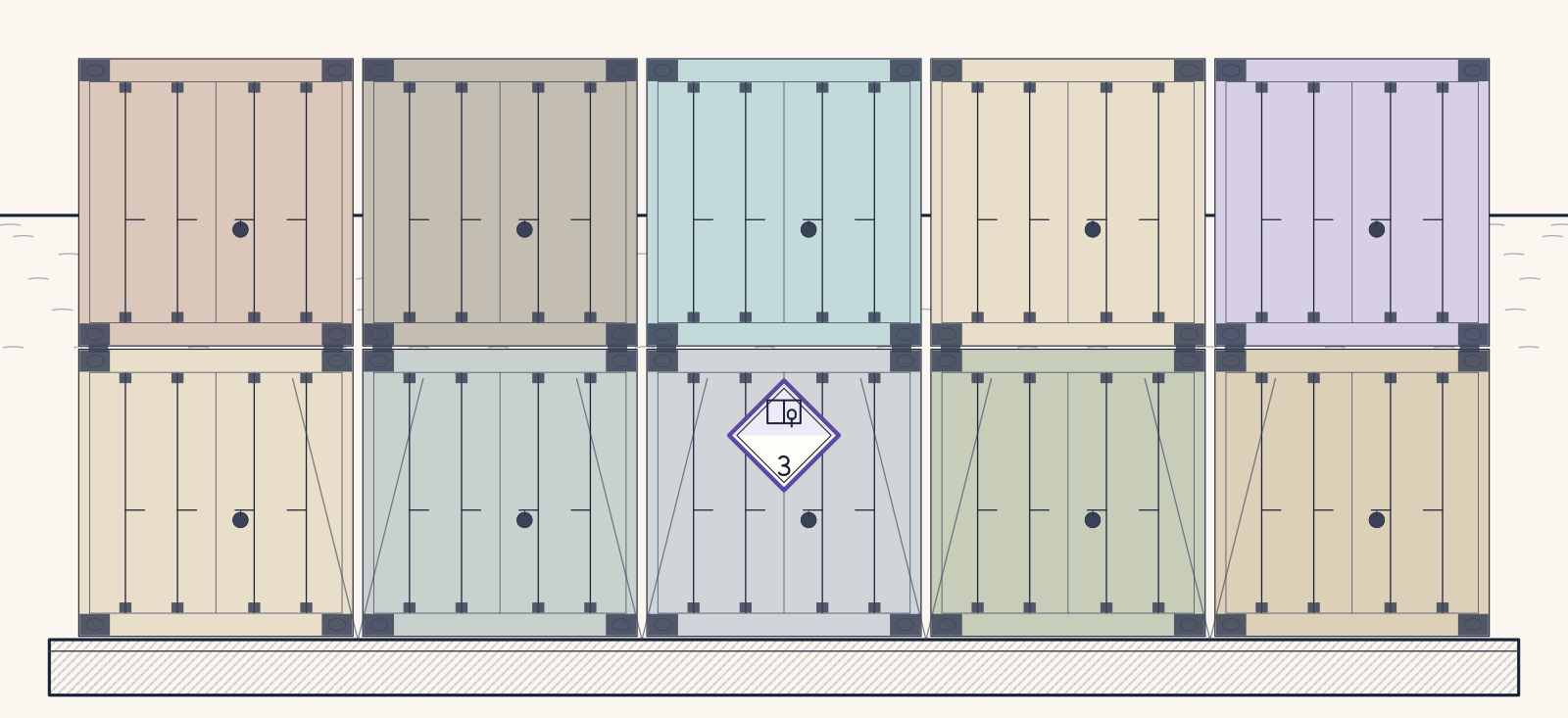
This chapter first explains the real systems accurately, because they already exist and work. Then it applies their logic, and then it says where the comparison fails.
Defined terms
Dangerous goods. Substances and articles that can harm people, ships, or the environment in transport. At sea, the rules for carrying them in packages are in the IMDG Code.1
Hazard class. The category of hazard assigned to a material under published criteria. U.S. regulations define it as “the category of hazard assigned to a hazardous material under the definitional criteria” and note that a material “may meet the defining criteria for more than one hazard class but is assigned to only one hazard class”.3
Placard. A sign fixed to the outside of a freight container or vehicle that shows the hazard class of what is inside, so handlers can see it without opening anything.4
Segregation. Keeping incompatible cargo apart. The IMDG Code covers “packing, container traffic and stowage, with particular reference to the segregation of incompatible substances”.1
Security level. Under the ISPS Code, one of three settings (normal, heightened, exceptional) that tells ships and port facilities which set of protective measures to apply.6
Handling level (this framework). A proposed setting, attached to a public question, that determines how carefully the framework treats opinions and group results on that question. It is a design proposal, not an existing standard. See the glossary entry.
Placarded issue (this framework). A question assigned the highest handling level because disclosing a view on it carries an unusually high risk of pressure, retaliation, or social cost.
How dangerous cargo is classified and marked
The dangerous goods system at sea rests on a treaty. The International Maritime Organization (IMO) explains that the Safety of Life at Sea Convention (SOLAS) “contains in chapter VII the mandatory provisions governing the carriage of dangerous goods in packaged form,” and that such carriage “shall comply with the relevant provisions of the International Maritime Dangerous Goods (IMDG) Code”.1
History. According to IMO, the Code “was initially adopted in 1965 as a recommendatory instrument” and was later given “a mandatory status under the umbrella of SOLAS Convention, from 1 January 2004,” although “some parts of the Code remain recommendatory”.1 Amendments run “on a two-year cycle,” and many of them track “changes to the United Nations Recommendations on the Transport of Dangerous Goods which sets the basic requirements for all the transport modes”.1 In other words, a ship, a truck, and a train use a shared classification so that a container can move between them without being relabeled from scratch.
Classes. The U.S. Hazardous Materials Regulations, which allow shipments to move “in accordance with the IMDG Code” when all or part of the movement is by vessel,5 list nine numbered classes: explosives (1), gases (2), flammable liquids (3), flammable solids and related materials (4), oxidizers and organic peroxides (5), poisonous and infectious substances (6), radioactive material (7), corrosive material (8), and miscellaneous hazardous material (9).2 Each class points to a written definition, so classification is a test against published criteria, not a judgment call made on the dock.
Placards. The label travels on the outside. U.S. rules require that each freight container “containing any quantity of a hazardous material must be placarded on each side and each end” with the specified placards.4 The placard serves people who will never see the shipping papers: crane operators, inspectors, and emergency responders.
Three features of this system matter for what follows. The criteria are published. The label describes the handling the cargo needs, not the character of the shipper. And handling, stowage, and segregation all follow from the label automatically, so no one has to make a fresh decision about each box.
How ships and ports raise security levels
Dangerous goods rules deal with what is inside a container. Security levels deal with threats from outside. The ISPS Code, IMO says, entered into force under SOLAS chapter XI-2 “on 1 July 2004” and “has since formed the basis for a comprehensive mandatory security regime for international shipping”.7 Its Part A is mandatory; Part B “provides a series of recommendatory guidelines”.7
IMO’s maritime security guidance defines three levels:6
| ISPS level | IMO description | Measures |
|---|---|---|
| Security level 1 | “normal, the level at which the ship or port facility normally operates” | “minimum appropriate protective security measures shall be maintained at all times” |
| Security level 2 | “heightened, the level applying for as long as there is a heightened risk of a security incident” | “appropriate additional protective security measures shall be maintained for a period of time” |
| Security level 3 | “exceptional, the level applying for the period of time when there is the probable or imminent risk of a security incident” | “further specific protective security measures shall be maintained for a limited period of time” |
The same guidance says level 3 “should be an exceptional measure applying only when there is credible information that a security incident is probable or imminent,” and that a level can move “directly from security level 1 to security level 3”.6 Levels are set by governments, not by individual ships: “the Contracting Government must set the appropriate security level,” and the level “creates a link between the ship and the port facility, since it triggers the implementation of appropriate security measures” for both.6
The United States version. U.S. federal regulations call these Maritime Security (MARSEC) Levels and define them in nearly identical words: MARSEC Level 1 means “minimum appropriate protective security measures shall be maintained at all times,” Level 2 adds measures “as a result of heightened risk of a transportation security incident,” and Level 3 applies “when a transportation security incident is probable or imminent”.8 The default is written into the rule: “Unless otherwise directed, each port, vessel, and facility shall operate at MARSEC Level 1”.9 The Coast Guard Commandant sets the level “commensurate with risk,” and a local Captain of the Port may raise it for a port or a specific operation.9
The lessons here are different from the placard lessons. Security levels are a dial, not a permanent label. Normal is the default. Raising the level is an accountable decision by a named authority. And each level comes with a plan written in advance, so the change in handling is predictable rather than improvised.
Placarded issues: applying the logic
Applied to civic participation, the two systems suggest a combined design. This is a design proposal for My Vote Forward, not an existing practice and not a tested result.
Most questions, most of the time, run at handling level 1. A few are placarded. The placard attaches to the question, never to a person and never to an answer. Every participant who answers a placarded question gets the same added protection, whatever they answer.
| Handling level | Plain description | Opinion sharing | Group results | Vote |
|---|---|---|---|---|
| 1, standard | Ordinary questions | Private by default; shareable item by item, as in Opinions | Published under the standard small-group rules in Small-group suppression | Sealed |
| 2, heightened | Questions with a known local or temporary disclosure risk | Private; no prompts or reminders to share | Larger minimum groups; fewer breakdowns by place or demographic | Sealed |
| 3, placarded | The most contested moral and political questions | Strictly voluntary: no prompts, no defaults, no “others shared” nudges, no display of who shared | The largest minimum groups; no small-area or small-demographic breakdowns; releases spaced further apart to limit differencing | Sealed |
The last column never changes. The secrecy of the official vote is not a dial in this framework. It is the hull. See Private voting.
Which issues. No list is fixed here, and any list is a judgment, not a finding. Questions that a governance body might consider for placarding include abortion policy, gun policy, immigration enforcement, policing, and policies concerning gender identity. These are named because people on every side of them report reasons to stay quiet, not because any position on them is risky to hold. Which questions qualify will differ by community and change over time, just as a security level changes with the threat.
Hypothetical example. A county runs a priorities exercise. “Road repair” is a level 1 subject: participation totals by precinct are published once the standard minimum is met. A question on a county policy about cooperating with federal immigration enforcement is placarded. No one is asked to share their view on it, the county total is published only once a much larger group has answered, and no precinct breakdown is released at all. A participant who supports the policy and a participant who opposes it receive exactly the same protection.
Evidence that disclosure risk varies by issue
The claim behind placarding is that revealing a view costs more on some questions than on others. Several lines of research support that claim, with limits.
Self-censorship is common and has grown. James L. Gibson and Joseph Sutherland report that from “the heyday of McCarthyism to the present, the percentage of the American people not feeling free to express their views has tripled,” and that “in 2020, more than four in ten people engaged in self-censorship”.10 They link self-censorship to affective polarization and suggest the driver may be “worrying that expressing unpopular views will isolate and alienate people from their friends, family, and neighbors”.10 They also report that “conservatives report engaging in more self-censorship than liberals (but this is not true when comparing Republicans with Democrats)”.10 That pattern is one reason the framework treats disclosure risk as something that can fall on any side.
People speak less when they expect disagreement. A Pew Research Center survey of “1,801 American adults” fielded “August 7-September 16, 2013” asked about government surveillance revealed by Edward Snowden. It found that “86% of Americans were willing to have an in-person conversation” about the program, but “just 42% of Facebook and Twitter users were willing to post about it,” and that “people were more willing to share their views if they thought their audience agreed with them”.11 This is one topic at one time, not a general law, but it shows that the setting and the expected audience change what people will say.
Sensitive topics distort survey answers. Roger Tourangeau and Ting Yan’s review in Psychological Bulletin found that “misreporting about sensitive topics is quite common and that it is largely situational,” and that respondents “edit the information they report to avoid embarrassing themselves in the presence of an interviewer or to avoid repercussions from third parties”.12 The review lists abortion among sensitive survey topics; in that literature the term usually refers to reporting personal experience rather than policy views, so it supports the general mechanism, not a claim about any policy question.
Indirect methods help, but not reliably. A meta-analysis of 89 articles on the item count technique, a method that lets people answer a sensitive question without revealing their own answer, found “a significantly positive pooled effect” on validity but also “pronounced heterogeneity,” indicating “uncertainty that ICT would work as intended in future studies”.13 Protection that hides the individual answer tends to produce more honest results, but no single technique is a guarantee. The framework’s broader treatment of this is in Opinion and choice and Question design.
What the analogy shows
Handling should follow published criteria. Cargo is classified against written definitions.2 Issues should be placarded against written criteria too, published before any question is assigned, so no one can placard a question because they dislike where it is heading.
The label belongs on the container, not the shipper. A placard tells handlers how to act. It does not accuse the shipper. A placarded issue tells the system how to act. It does not judge the people answering.
Normal is the default; raising the level is accountable. MARSEC Level 1 is the rule “unless otherwise directed,” and a named official raises it.9 Most questions should run at level 1, and every move to level 2 or 3 should name who decided and why.
Plans are written before the level changes. Ports implement measures already in their security plans.9 The handling for each level should likewise be fixed in advance, not invented when a heated question arrives.
Where the analogy breaks
An issue is not dangerous goods. A flammable liquid is hazardous because of tested physical properties. A public question is sensitive because of how people react to one another. The risk sits in the social setting, not in the question, and it can change from town to town.
People are not hazards. In shipping, the placard protects handlers from the cargo. Here the protection runs the other way: it protects the person answering from pressure by others. No participant, and no view, is the thing being contained.
Placarding is about handling care, never about labeling a side as dangerous. A framework that placarded only questions where one side’s view was unpopular would be taking a side. That is why the placard attaches to the question and gives every answer the same protection.
A security level is a temporary response; some issues stay contested for decades. The ISPS model expects level 3 for “a limited period of time”.6 Some placarded questions may stay placarded for a long time, which means the extra caution has a lasting cost in published detail.
Shipping has a regulator; this framework does not. Governments set ISPS levels under a treaty.6 Nothing comparable assigns handling levels to civic questions. That authority would have to be created, and checked, by governance.
Competing interpretations
“Placarding signals that a topic is too dangerous to discuss.” One concern is that marking a question for special handling tells people the topic is taboo, which could deepen the silence Gibson and Sutherland describe. The framework’s answer is that placarding changes only how the system stores and publishes data. It places no limit on what anyone may say anywhere. Whether participants will read it that way is an open, testable question.
“Larger minimum groups erase small communities on exactly the questions where they differ most.” As Small-group suppression explains, protection always costs detail, and small groups pay first. Placarding increases that cost on the questions some communities care about most. Coarsening areas rather than deleting them reduces, but does not remove, that cost.
“Who decides what is contested is itself contested.” Any body that assigns handling levels gains influence over what gets measured in detail. Critics on any side could see placarding as a way to bury results they would rather see published. Published criteria, cross-perspective review, and a public log of every level change are the proposed safeguards; whether they are enough is debatable.
“Everyone deserves level 3 protection on everything.” Another view holds that the safest design would treat every question as placarded. The cost is less useful group information everywhere. The framework treats this as a reasonable position and an open trade-off, discussed in Tradeoffs.
Application to this framework
These are design proposals, not settled rules.
- Publish the criteria first. A question may be raised above level 1 only against written criteria, such as documented evidence of retaliation or self-censorship on that question in the relevant community.
- Attach the level to the question, symmetrically. Every answer to a placarded question receives identical treatment. No answer is flagged.
- Remove all nudges at level 3. No reminders to share, no counts of how many others shared, no social prompts. Sharing remains possible, item by item, under Consent.
- Raise the publication floor. Minimum group sizes and spacing between releases increase with the level; the exact numbers belong to the privacy design described in Published releases and are not yet set.
- Log every level change. Each change names the decision maker, the criteria met, the date, and the review date, mirroring how a security level is set and lifted.
- Never touch the seal. No handling level changes the secrecy of a vote. See Intimidation.
What My Vote Forward can and cannot do here
Can: publish handling criteria, attach handling levels to questions, remove sharing prompts, raise minimum group sizes, limit breakdowns, log every level decision, and explain these choices in plain language on the demo, which uses simulated data.
Cannot: make social pressure disappear, guarantee that no one is ever identified (no “fully anonymous” claim is made), decide which views are acceptable, or claim that the IMO, the Coast Guard, or any standards body endorses this analogy. The maritime codes are cited to explain how they work, not as approvals of this project. My Vote Forward does not conduct official votes.
Unresolved questions
- What evidence should be required before a question is placarded, and who gathers it without bias?
- Should handling levels differ by community, given that the same question may be quiet in one place and heated in another?
- Does placarding a question reduce self-censorship, increase it, or make no difference? This could be tested; see Evaluation.
- How large should the minimum group be at each level, and how should that interact with differential privacy?
- How is a level lowered, and who notices when a question no longer needs the extra care?
Sources
- International Maritime Organization, “The International Maritime Dangerous Goods (IMDG) Code,” accessed October 26, 2026. imo.org/…
- 49 CFR § 173.2, “Hazardous material classes and index to hazard class definitions,” Table 1 (amended 87 FR 79774, December 27, 2022), via Cornell Legal Information Institute. law.cornell.edu/cfr/text/49/173.2
- 49 CFR § 171.8, “Definitions and abbreviations,” via Cornell Legal Information Institute. law.cornell.edu/cfr/text/49/171.8
- 49 CFR § 172.504, “General placarding requirements,” via Cornell Legal Information Institute. law.cornell.edu/cfr/text/49/172.504
- 49 CFR § 171.25, “Additional requirements for the use of the IMDG Code,” via Cornell Legal Information Institute. law.cornell.edu/cfr/text/49/171.25
- International Maritime Organization, “Maritime Security: Frequently Asked Questions,” accessed October 26, 2026. imo.org/en/OurWork/Security/Pages/FAQ.aspx
- International Maritime Organization, “SOLAS XI-2 and the ISPS Code,” accessed October 26, 2026. imo.org/…
- 33 CFR § 101.105, “Definitions,” via Cornell Legal Information Institute. law.cornell.edu/cfr/text/33/101.105
- 33 CFR § 101.200, “MARSEC Levels,” via Cornell Legal Information Institute. law.cornell.edu/cfr/text/33/101.200
- James L. Gibson and Joseph Sutherland, “Keeping Your Mouth Shut: Spiraling Self-Censorship in the United States,” Political Science Quarterly 138(3), 2023, pp. 361 to 376. doi.org/10.1093/psquar/qqad037
- Keith Hampton, Lee Rainie, Weixu Lu, Maria Dwyer, Inyoung Shin, and Kristen Purcell, “Social Media and the ‘Spiral of Silence’,” Pew Research Center, August 26, 2014. pewresearch.org/…
- Roger Tourangeau and Ting Yan, “Sensitive Questions in Surveys,” Psychological Bulletin 133(5), 2007. doi.org/10.1037/0033-2909.133.5.859
- Ingmar Ehler, Felix Wolter, and Justus Junkermann, “Sensitive Questions in Surveys” (a meta-analysis of item count technique experiments), Public Opinion Quarterly 85(1), 2021, pp. 6 to 27. doi.org/10.1093/poq/nfab002

